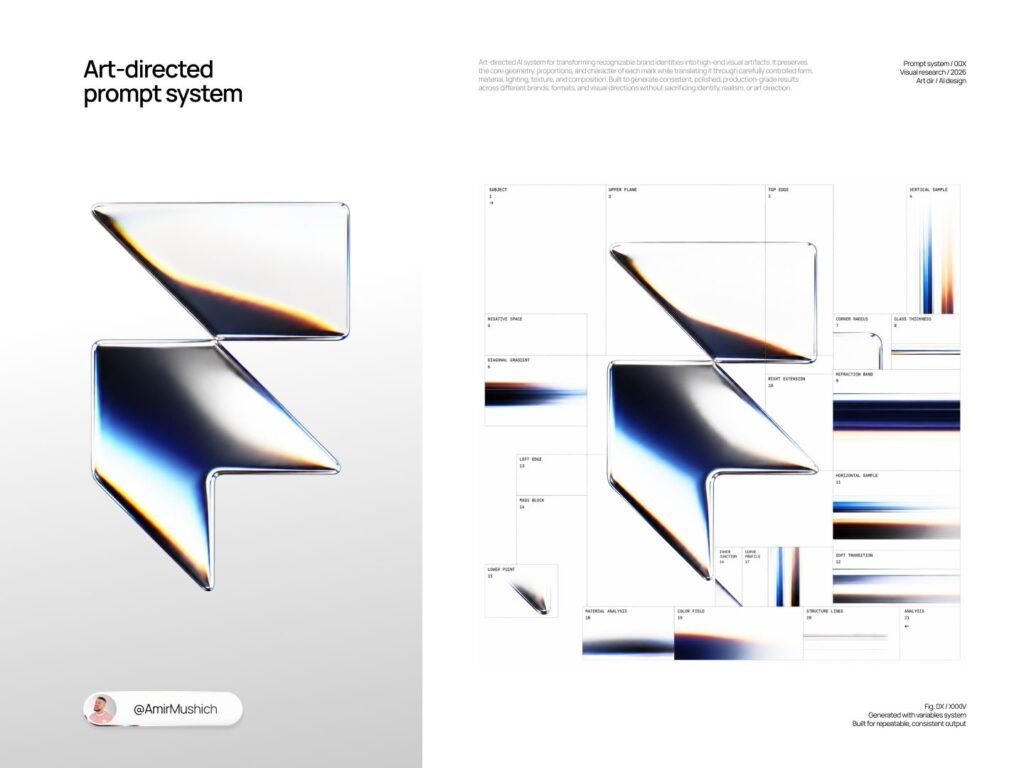
AI prompt turns any image or logo into a pixel-slice deconstruction. Ideal for premium brand design assets.
How to use the prompt
Variables: [SOURCE MODE], [BACKGROUND COLOR].
Replace [SOURCE MODE] with ATTACHED IMAGE or LOGO, and [BACKGROUND COLOR] with the background color (e.g. white). Then paste the full prompt into GPT Image (attach an image if using ATTACHED IMAGE mode).
(attach your image before generating)
This prompt works great for websites, social media, pitch decks, packaging, or any project that needs polished modern brand visuals.
[SOURCE MODE = ATTACHED IMAGE]

Create a image 16:9 experimental graphic composition using a recognition-preserving annotated pixel-slice deconstruction system.
SOURCE PRIORITY
The original source is the dominant master layer.
The analytical grid, annotations and pixel-stretch effects are secondary overlays applied around and selectively across the source.
Never reconstruct the subject from separate grid fragments.
Never turn the source into a collage of disconnected crops.
The complete original subject must remain immediately recognizable at first glance before the viewer notices the analytical distortion system.
If [SOURCE MODE = ATTACHED IMAGE], use the uploaded image as the sole visual source. Preserve its actual subject, silhouette, proportions, pose, orientation, perspective, internal geometry, colors, material appearance and major recognizable features.
If [SOURCE MODE = LOGO], automatically identify the authentic official standalone symbol of [LOGO NAME]. Preserve its canonical silhouette, proportions, curves, stroke relationships, counterforms, internal negative spaces, intersections and component spacing. Do not redesign, simplify or reinterpret the mark.
RECOGNIZABILITY LOCK
Preserve approximately 60–75% of the visible source as continuous, undistorted imagery.
At least one large uninterrupted region must show most of the source in its original spatial arrangement.
The viewer must be able to mentally reconstruct the entire source without effort.
Protect all identity-critical geometry from destructive distortion:
— outer silhouette;
— primary junctions;
— distinctive corners and curves;
— central intersections;
— negative spaces;
— major directional axes;
— defining internal relationships between parts.
Do not place heavy pixel stretching across these critical recognition anchors.
If distortion would weaken recognition, reduce the distortion rather than modifying the source geometry.
The source should remain spatially coherent underneath the graphic system.
CORE VISUAL SYSTEM
Build an irregular architectural grid of approximately 18–30 rectangular analytical cells around and partially through the source.
The grid should feel like an experimental scientific image-analysis interface, dataset annotation sheet and corrupted editorial layout merged into one system.
The source remains the hero.
The grid must behave like a layer placed over and around an already complete image, not like a structure used to rebuild it.
Allow the grid to extend into surrounding negative space, intersect the source at selected locations and isolate small analytical samples from it.
Use a few large anchor cells, several medium cells and narrow micro-cells with asymmetric stepped relationships.
Most cells should share boundaries or connect structurally.
Do not use an even checkerboard.
Do not cover the entire source with grid divisions.
Do not force every visible part of the source into a separate rectangle.
SOURCE CONTINUITY
Where grid lines cross the undistorted source, the image underneath must continue seamlessly across adjacent cells.
A grid boundary should not automatically create a new crop.
The same original object must remain positionally aligned from one cell to the next.
Do not shift, rescale, rotate or independently reposition adjacent source fragments.
Do not duplicate distinctive parts of the source unless intentionally used as a small analytical sample.
The grid is graphic segmentation, not physical fragmentation.
PIXEL-SLICE DECONSTRUCTION
Apply pixel stretching only to selected secondary cells.
Use approximately 20–35% of the grid cells for strong distortion.
Sample very narrow strips directly from nearby regions of the source and stretch them across the selected cell.
Create:
— vertical source slices extended into vertical spectral bands;
— horizontal source slices extended into horizontal bands;
— compressed local color profiles;
— elongated texture streaks;
— repeated edge-color information;
— smooth raster smear fields derived directly from the source.
The distorted sample must remain visually related to the exact neighboring area it was extracted from.
Whenever possible, place stretched cells directly beside the intact region they analyze, creating a clear visual relationship between source and sample.
Do not replace a large recognizable portion of the source with distortion.
Do not stretch the entire object.
Do not let distorted cells become more visually dominant than the original source.
IMAGE CELL HIERARCHY
Use three clear cell types:
1. PRIMARY SOURCE CELLS
Large cells containing continuous undistorted portions of the original source.
These carry most of the recognizability.
2. ANALYTICAL SAMPLE CELLS
Smaller cells containing pixel-stretched or isolated source samples.
3. EMPTY INFORMATION CELLS
Background-only cells containing a label, index number or nothing at all.
Primary source cells should dominate the composition by area.
Analytical sample cells should behave like extracted measurements surrounding the source.
Empty cells create breathing room and prevent the composition from becoming a dense mosaic.
ANNOTATION SYSTEM
Give selected cells tiny technical annotations positioned near the upper-left corner.
Automatically derive concise semantic labels from the actual source:
SUBJECT
SILHOUETTE
CURVATURE
EDGE
JUNCTION
REFLECTION
CONTOUR
NEGATIVE SPACE
MATERIAL
GRADIENT
STRUCTURE
COLOR FIELD
VERTICAL SAMPLE
HORIZONTAL SAMPLE
INTERSECTION
PROFILE
Use uppercase condensed grotesk or monospaced technical typography.
Typography should be black or near-black on light backgrounds and adapt subtly for dark backgrounds.
Keep all labels very small.
Pair labels with sequential index numbers such as 1, 2, 3, 4…
Occasionally use a tiny arrow, dash or technical symbol.
Never allow text to become a headline or compete visually with the source.
GRID GRAPHICS
Use extremely thin neutral-gray or near-black hairline rules.
Keep borders precise, flat and diagrammatic.
Grid lines may cross the source, but crossing a grid line must not automatically distort or relocate the image.
Allow some cells to extend completely into empty background space.
The overall footprint should be asymmetric and architectural, with occasional stepped protrusions and isolated narrow analytical columns.
BACKGROUND + NEGATIVE SPACE
Use [BACKGROUND COLOR] as the surrounding field and empty-cell color.
Keep approximately 40–60% of the total canvas visually quiet.
Large areas of untouched background are essential.
Do not surround the entire source with equally dense cells.
Concentrate more analytical activity in two or three localized zones and allow other areas to remain calm.
COMPOSITION
Square 1:1 canvas.
Preserve the original source orientation and major compositional balance.
Keep the subject large enough to be recognized instantly.
Do not aggressively zoom into isolated details at the expense of the whole object.
The intact source should form one dominant visual mass.
The analytical grid should form a secondary asymmetric constellation around and partially across it.
The final composition should read in this order:
1. recognizable original subject;
2. analytical rectangular system;
3. pixel-stretch details;
4. micro-annotations.
Never reverse this hierarchy.
RENDER CHARACTER
Extremely crisp 2D graphic design.
Preserve the original photographic, rendered or vector-like character of the source inside undistorted regions.
Combine it with precise raster stretching, exact rectangular clipping, thin diagrammatic rules and restrained technical typography.
No added physical depth or material treatment beyond what already exists in the source.
NEGATIVE CONSTRAINTS
Do not rebuild the subject from independent rectangular fragments.
Do not turn the source into a contact sheet.
Do not create a mosaic.
Do not destroy the overall silhouette.
Do not split every part of the object into separate cells.
Do not independently reposition adjacent source fragments.
Do not duplicate major recognizable features.
Do not crop away identity-critical regions.
Do not let distorted samples occupy more visual area than the intact source.
Do not create generic cyberpunk glitch art.
No RGB channel separation.
No VHS noise.
No scanlines.
No datamoshing.
No JPEG artifacts.
No random pixel blocks.
No unrelated gradients.
No arbitrary neon colors.
No regular checkerboard.
No uniform modular grid.
No oversized typography.
No decorative UI icons.
No fake charts.
No complete source abstraction.
FINAL PRIORITY
If any instruction conflicts with source recognizability, preserve recognizability first.
The finished image must look like a complete original image being analytically sampled, segmented and partially stretched by an external graphic system — never like the original image was destroyed and reconstructed from glitch fragments.