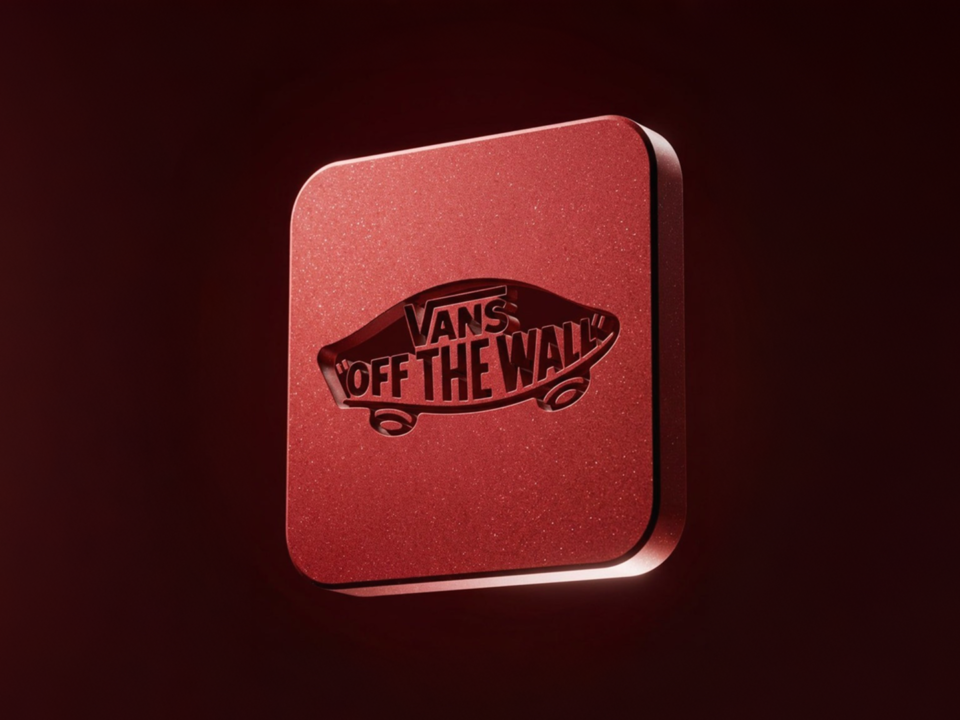
2-variable AI prompt turns any logo into a 3D black metal logo. Ideal for premium brand design assets.
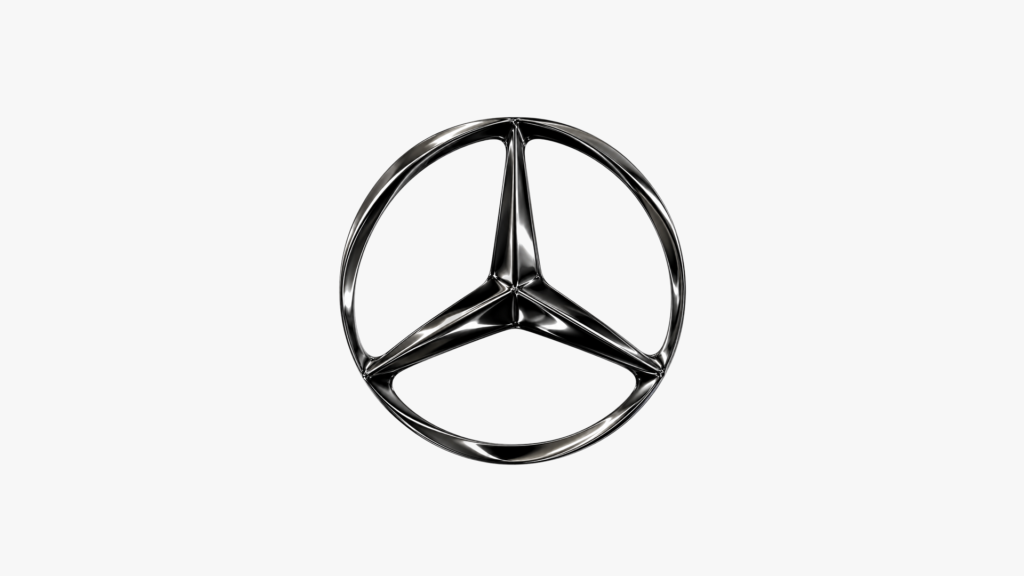
How to use the prompt
Variables: [BRAND NAME], [BACKGROUND COLOR].
Replace [BRAND NAME] with the logo you want (e.g. Nike), [BACKGROUND COLOR] with the background color (e.g. black). Then paste the full prompt into GPT Image.
This prompt works great for websites, social media, pitch decks, packaging, or any project that needs polished modern brand visuals.
[BRAND NAME = ______________]
[BACKGROUND COLOR = _____]
Create a square 1:1 experimental studio CGI visualization of the authentic official symbol of [BRAND NAME], translated into a shallow tensioned-metal membrane: a continuously warped blackened mirror-metal surface defined by asymmetric convex peaks, deep concave valleys, saddle-like junctions, pinched reflective ridges and sparse razor-bright specular ribbons.
BRAND ACCURACY
Automatically identify the most recognizable authentic official standalone symbol of [BRAND NAME]. Preserve its canonical silhouette, proportions, stroke relationships, curves, intersections, counterforms, internal negative spaces and component spacing.
Do not redesign, simplify, combine or reinterpret the identity. If the official mark contains separated components, preserve their authentic structure and placement. Use the official wordmark only when no recognizable standalone symbol exists.
Ignore native brand colors. Apply the fixed form and material system below.
CORE TRANSFORMATION
Do not treat the logo as a flat graphic that has simply been extruded, beveled or coated in chrome.
Treat the authentic 2D boundaries of the logo as structural constraints for a continuous metallic deformation field.
Transform the interior geometry into a shallow tensioned membrane whose surface is locally pulled toward and away from the camera.
The original logo must remain immediately recognizable from its silhouette and internal topology, but its surface should behave like thin rigid metal subjected to controlled tension: stretched, pinched, swollen and drawn inward at selected structural regions.
Keep overall physical depth shallow, approximately 8–15% of the average local stroke width.
Strong dimensionality must come from surface-normal variation rather than thick extrusion.
There must be no single uniform cross-section.
Different regions should transition between:
— broad shallow convex areas;
— narrow raised specular ridges;
— deep smooth concave channels;
— hyperbolic saddle surfaces;
— stretched valleys;
— pinched junctions;
— compressed cusps;
— locally flattened tension zones.
These changes must arise from the authentic geometry of the mark.
Do not add arbitrary decorative geometry.
DEFORMATION FIELD
This is the defining feature of the image.
Within each stroke, enclosed region or structural junction, create a smooth but uneven tension field.
Avoid making every stroke into a rounded tube.
Allow the highest ridge to drift away from the geometric centerline.
One side of a stroke may remain broad and shallow while the opposite side drops rapidly into a dark concavity.
At intersections, overlaps and close structural relationships, let adjacent curvature fields interact.
Surfaces should flow into one another through saddle-shaped transitions rather than appearing as independent extruded parts.
Important intersections may form concentrated stretched nodes where several curved surfaces converge into one bright pinched ridge surrounded by darker concave areas.
For solid logo shapes, treat the entire silhouette as one stretched metallic skin rather than one inflated blob.
For linear logos, preserve individual authentic strokes but deform their internal cross-sections asymmetrically.
For wordmarks, preserve canonical typography exactly while applying the deformation field inside each authentic letterform.
For complex illustrative symbols, preserve the authentic visible topology and transform its existing masses and lines into the same continuous tension system; do not invent a simplified substitute symbol.
CROSS-SECTION AND EDGE ARCHITECTURE
Do not construct the object from a recognizable front face, bevel and sidewall.
There should be no visible conventional extrusion topology.
No identifiable bevel band.
No uniform chamfer.
No separate flat face.
No obvious vertical sidewall.
Instead use one continuous warped cross-section:
compressed outer edge → steep curved descent or rise → asymmetric interior ridge or valley → opposing curved transition → compressed edge.
The perimeter may locally become extremely thin and optically sharp, but it must remain part of the same continuous surface.
Where curvature fields naturally converge, allow selected regions to terminate in extremely narrow cusps or pinched ridges.
These sharp regions must result from surface tension, not decorative spikes.
Some contours may produce hairline reflections while adjacent sections almost disappear into darkness.
CONTROLLED GEOMETRIC IRREGULARITY
The object must not feel mathematically uniform or conventionally CAD-beveled.
Introduce restrained asymmetry in the deformation:
— unequal curvature between neighboring regions;
— off-center ridges;
— varying compression along one contour;
— localized stretched surfaces;
— subtle differences in apparent thickness;
— irregular but smooth tension around intersections.
The surface itself remains perfectly polished and clean.
No surface damage, noise or rough sculpting.
All irregularity comes from geometry.
MATERIAL
Use blackened mirror-polished nickel-chrome / smoked silver metal.
The underlying material must appear predominantly charcoal, graphite and near-black.
Do not make the object visually bright silver overall.
Approximate visual balance across the object:
60–75% deep black / graphite reflection;
15–30% dark-to-middle silver;
5–10% intense near-white specular reflection.
Metallic response: fully metallic.
Primary roughness approximately 0.025–0.06 on highly polished regions, with restrained local variation up to approximately 0.10 inside selected dark curved areas.
Use physically accurate Fresnel behavior and strong grazing-angle reflections.
No brushed grain.
No machining marks.
No scratches.
No hammered texture.
No fingerprints.
No surface bump.
No glitter.
No pearlescence.
The surface should feel dense, cold, rigid and perfectly smooth.
Its tactile richness comes entirely from changing curvature and reflected light.
SHADING
Do not rely on diffuse shading to describe the object.
The metal should receive extremely little visible diffuse illumination.
Form must be revealed primarily by the interaction between curved surface normals and the reflection environment.
Convex or tilted areas may catch silver-white reflections.
Surfaces turning away from the reflection cards should fall rapidly into charcoal or almost pure black.
Concave regions should frequently become darker than surrounding surfaces.
At selected tension nodes, bright reflections may compress into concentrated white knots or narrow streaks.
Avoid smooth evenly distributed chrome gradients.
The transition between reflection states should often be abrupt:
near-white → silver → graphite → near-black.
LIGHTING AND REFLECTION CHAMBER
Treat the scene as a dark controlled reflection chamber rather than a normally illuminated product studio.
The visible appearance of the sculpture must be generated mostly by black reflection cards and a very small number of precisely shaped white sources.
Use one large elongated neutral-white strip source positioned above and slightly forward of the object.
Its main purpose is to create one or several long flowing white reflection ribbons across selected upward-facing curvature.
Add a second narrower elongated white source from upper-left or left, positioned to create another isolated curved highlight along selected outer surfaces.
Optionally use one extremely narrow weak strip from an opposing angle to generate occasional hairline specular edges.
Keep direct frontal illumination extremely low.
Surround the object outside the camera frame with extensive matte-black flags.
Most directions reflected by the metal should therefore appear black.
The reflection system should produce:
— large near-black areas;
— isolated broad silver bands;
— narrow high-energy white ribbons;
— hairline white edge reflections;
— dark concave channels;
— occasional concentrated specular nodes.
Do not illuminate every edge.
Do not create a continuous luminous perimeter.
Do not distribute highlights symmetrically.
Do not use a generic HDRI environment.
Do not use colored key lights.
Keep reflections neutral white to silver, with only negligible environmental tint.
BACKGROUND
Use [BACKGROUND COLOR] literally as the visible seamless studio background color.
Do not automatically darken or reinterpret the requested background.
If [BACKGROUND COLOR] is black, use a deep matte near-black field with subtle tonal separation from the blackened metal.
If [BACKGROUND COLOR] is white or light, preserve a genuinely white or light matte background while keeping the object internally dark through off-camera black reflection cards.
The background must not determine the reflected brightness of the entire metal sculpture.
Use controlled flags and reflection cards to maintain deep black regions even against a white background.
Keep the background extremely clean and visually quiet.
No obvious halo.
No glowing aura.
No vignette ring.
No floor horizon.
No visible studio environment.
COMPOSITION
Square 1:1.
Center the authentic symbol according to its natural visual balance.
Scale it to approximately 65–75% of the available frame while keeping the complete canonical silhouette visible.
Preserve generous negative space.
The object floats independently in space.
No backing plate.
No frame unless it is an authentic part of the official mark.
No pedestal.
No mounting hardware.
No floor.
No support.
No conventional drop shadow or contact shadow.
CAMERA
Near-frontal camera with very low perspective distortion.
Use long-lens compressed perspective equivalent to approximately 100–135 mm.
Yaw and pitch approximately 0–3 degrees only.
The result should retain the immediate graphic read of the original logo.
Do not turn it into a dramatic three-quarter product sculpture.
DEPTH OF FIELD
Keep almost the entire object sharply resolved.
Use approximately f/8–f/11 equivalent depth behavior.
Only extremely distant or razor-thin geometry may soften imperceptibly.
No obvious shallow depth of field.
No macro bokeh.
RENDER CHARACTER
Path-traced experimental industrial-design CGI.
Very high surface subdivision.
Perfectly continuous normals.
Physically believable metal reflections.
Extremely clean geometry but non-uniform deformation.
Deep blacks with strong local specular contrast.
The render should feel closer to an experimental polished-metal sculpture photographed in a controlled reflection chamber than to a conventional luxury logo mockup.
Apply only restrained finishing:
— extremely subtle highlight bloom on the brightest reflection ribbons;
— very fine monochromatic analogue grain;
— slight optical softness around extreme highlights.
Do not soften the geometry itself.
NEGATIVE CONSTRAINTS
No conventional 3D extrusion.
No rounded tubular strokes.
No inflated balloon geometry.
No uniformly convex cross-section.
No flat front faces.
No recognizable bevel band.
No conventional chamfer.
No visible sidewalls.
No thick badge construction.
No evenly polished chrome logo.
No bright silver object overall.
No uniform chrome outline.
No glowing contour.
No neon.
No generic softbox gradient across every surface.
No symmetrical reflection pattern.
No decorative spikes.
No fantasy blades.
No tentacles.
No melting.
No liquid droplets.
No transparent glass.
No plastic.
No rubber.
No brushed metal.
No scratches.
No distressed surface.
No backing plate.
No pedestal.
No floor.
No strong cast shadow.
No dramatic perspective.
No wide-angle camera.
No shallow macro DOF.
FINAL PRIORITY
The authentic identity of [BRAND NAME] must remain intact, but the transformation must go substantially beyond applying chrome material to an extruded logo.
The defining visual system is:
authentic 2D logo boundaries → shallow continuous metallic membrane → asymmetric deformation field → alternating convex and concave topology → saddle-like intersections and pinched ridges → predominantly blackened mirror metal → sparse intense white reflection ribbons inside a mostly black reflection environment.
The result should read first as the authentic [BRAND NAME] symbol and immediately afterward as an unfamiliar, tensioned, sculptural metal surface whose apparent complexity comes from curvature and reflection rather than thickness, texture or ornament.